Iris Reproduction

Iris Reproduction

Recently, a question was presented to me, “Can one pollen grain fertilize all the ovules in an iris flower?”  I will attempt to answer this question and add what I hope will be some interesting facts about iris reproduction.  

Highly successful land plants, such as irises, have two different plant forms (sporophyte and gametophyte) that alternate in each generation between a diploid sporophyte organism designed to resist drying out and haploid organisms (pollen or microgametophytes and ovules containing macrogametophytes) that require a moist environment inside the sporophyte where fertilization takes place.  Each sporophyte microspore mother cell produces by meiosis (reduction and division, 2N to 1N sets of chromosomes, or in tetraploids 4N to 2N) four microspores that develop into four binucleate pollen grains with tough coats. Irises are seed plants (Angiosperms) with one embryonic seed leaf (Monocotyledons) and leaves with parallel venation.  Irises advance the basic lily plan and reduce the flower parts, which are basically modified leaves, from multiples of six to three.   

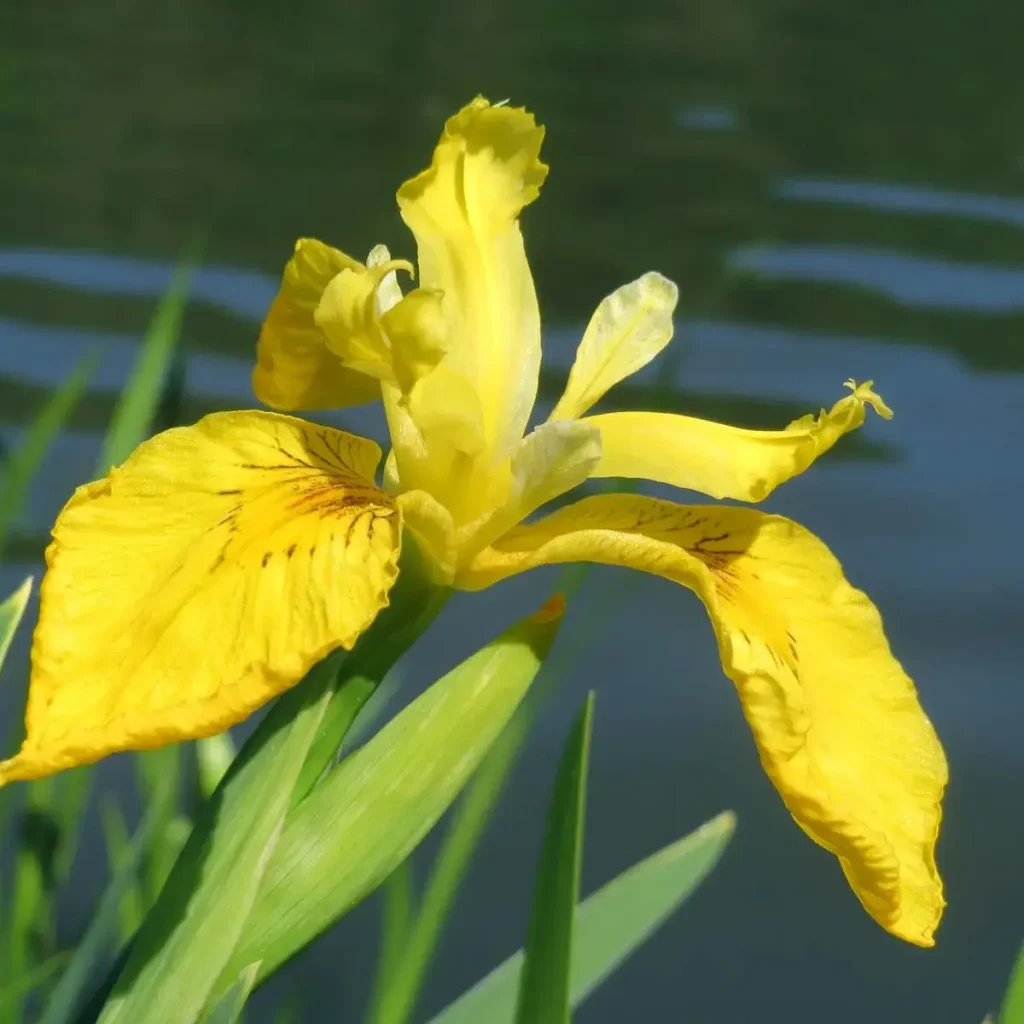
The female part of the iris flower is the pistil composed of  the stigma, the style, and the ovary. The male part is the stamen made of the attachment filament and the anther with four long, parallel pollen sacs. The pollen is not “ripe” until the pollen sacs open and the puffy masses of pollen are apparent.  If  the nourishing filament of the stamen is broken too early when the pollen sacs are immature, the pollen may be of no use. The stigma has a sticky secretion that not only holds the pollen grains, but also contains various nourishing chemicals, such as sugars, that causes the pollen grain organisms to germinate and build the pollen tubes that digest their way with enzymes as they descend down the style tissue to the ovary. The pollen grain is remarkably resistant to drying and has one tiny area where the germinating pollen grain organism will emerge. The ovary contains the ovules, each with two coverings (integuments) that surround the multicellular macrogametophytes in their little “moist pond.”
Iris Reproduction

The surrounding integuments that later develop into the two seed coats leave a tiny opening, the micropyle, for the pollen tube to enter.  A tall bearded iris can have at most, about one hundred ovules distributed in the three chambers of the ovary. This threefold redundancy may be useful, since a Verbena bud moth larva that may penetrate the developing pod usually does not go from one ovary chamber to the next and destroy all the seeds. The ovules are lined up in rows and held by stalks though which they receive nourishment as they develop into seeds (analogous to multiple fetuses in a mammalian womb). The central region of the ovary that the ovules stalks attach to is called the placenta.  If the iris pod is broken from the stalk too early, the small seeds may be underdeveloped and unable to germinate or grow.

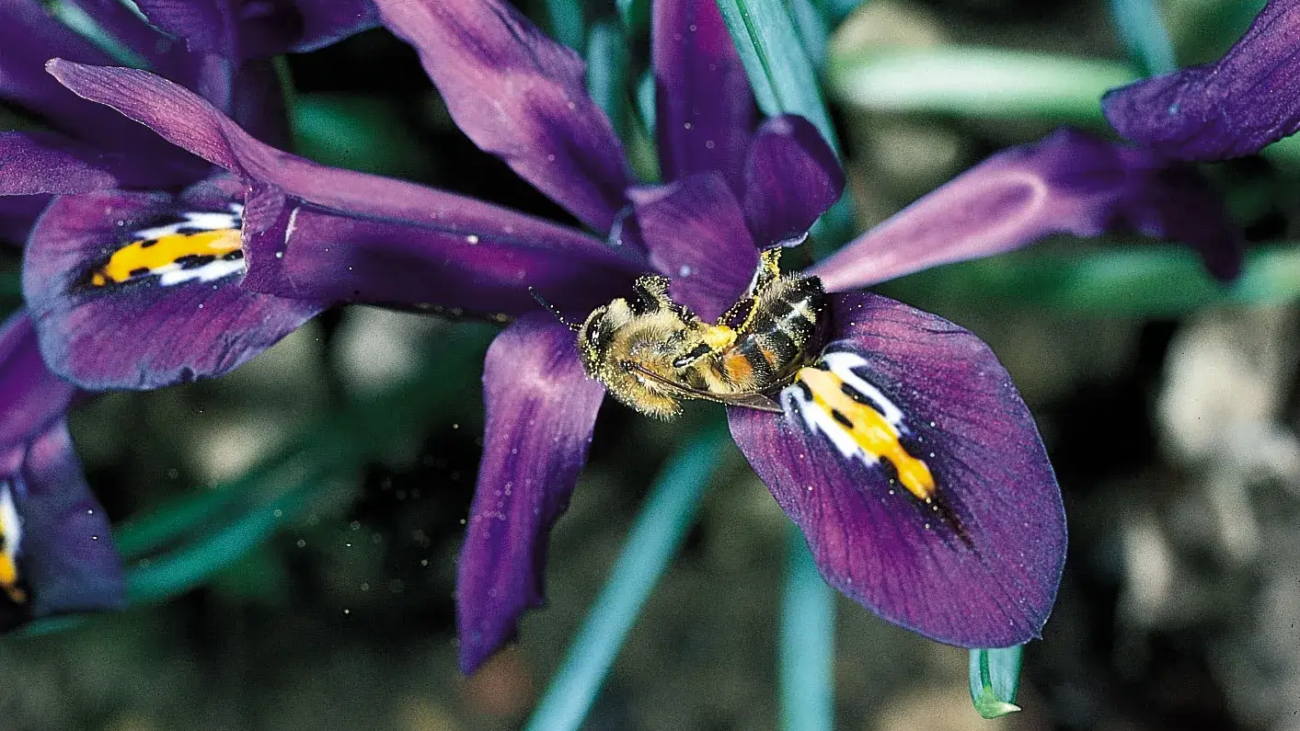
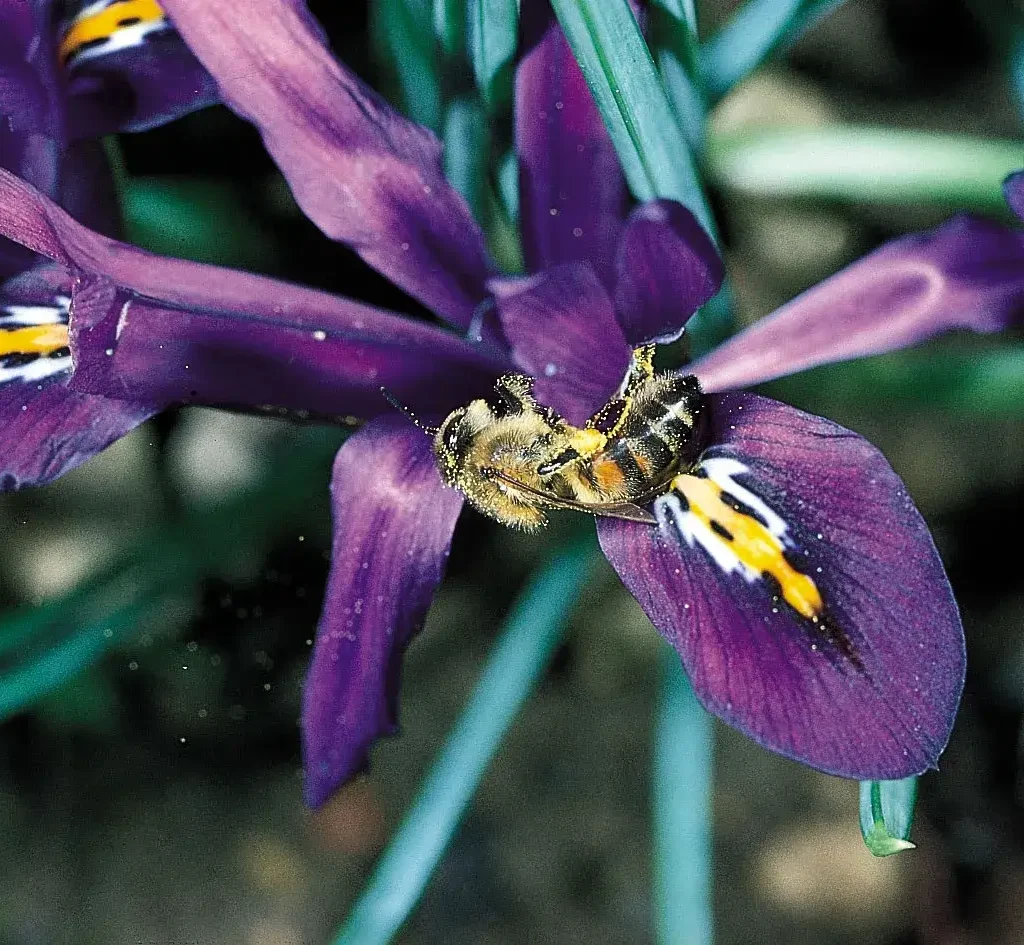
When the pollen grains are applied onto the stigmatic lip of the iris flower by the insect or human pollinator, there can be thousands that will germinate and form pollen tubes.  From that moment the race is on, and when all ovules are reached, all Johnny-come-lately pollen tubes are essentially lost. There will be just one winning pollen grain’s pollen tube reaching each ovule, so there’s your answer.  One pollen grain pollinates one ovule, and only one.  The pollen will germinate in minutes on the stigmatic lip.  Each pollen grain will take about eight hours to grow a pollen tube down through the style arms to the ovary and finally growing to and into the ovule opening.  If the pollen is applied on only one of the three stigmatic lips, the pollen tubes will still go into all three chambers of the ovary and may fertilize all the ovules. Most hybridizers apply pollen to all three stigmatic lips. The fertilized ovary will swell and grow into a pod as the stalk gains strength and resiliency. In about two months the pod will dry, turn tan, and begin to crack at the end.  At this point, harvest the pod in a folded paper sandwich bag and place it in a cool place for a couple of weeks while the seeds harden, then they can be separated from the dried, brown pod walls. 

If the hybridizer is too rough while daubing pollen, the style arms may be broken, and the pollen tubes in the broken style arms can’t reach the ovary.  If there is rain, hail, strong winds, frost, or overly hot conditions, the pollination can fail.  You need to make the cross at least three hours before rain occurs, otherwise you can cover the flower with a plastic bag with the top corner cut out so it will not overheat inside the bag. Some hybridizers strip off all three falls and cover the cross with a section of nylon stocking so no interloping insect will enter with unwanted pollen. 

The preeminent moment of  iris reproduction occurs when the pollen tube enters the ovule.  But before entering, led by the pollen tube nucleus, the generative nucleus following behind divides by mitosis to produce two haploid nuclei.  The pollen tube, relative to its thickness, is an extremely long filament filled with cytoplasm, yet it contains no proplastids that will develop into chloroplasts, thus the chloroplasts and their DNA only come from the pod parent and the egg cell of the ovule microgametophyte.  Since the chloroplasts power the plant’s photosynthesis, it is easy to understand why it is always best to use as the pod parent the most vigorous parent.  If you want to obtain variegated foliage, you must have the trait in the pod parent as Allan Ensminger discovered.  The gene that produces the variegated foliage trait is most likely in the chloroplast DNA. 

Once the two sperm nuclei enter the iris ovule a most remarkable thing happens; there is not one, but two fertilizations.  One haploid sperm nucleus unites with the macrogametophyte cell that contains the haploid egg nucleus to produce the diploid sporophyte zygote. The other sperm nucleus produces the triploid endosperm by uniting with the diploid nucleus of the central cell formed from fusing two cells of the macrogametophyte.  The other five cells, of the total of eight that made up the macrogametophyte produced from three divisions of one megaspore, are transient and play minor accessory roles. Then, both zygote cell and the endosperm cell increase by cell division (mitosis) which eventually ceases as the seed coat dries and hardens, and the enclosed embryo with its attached endosperm becomes dormant. By analogy, the endosperm is to the iris embryo what an egg yolk sac is to the embryo of a fish, amphibian, reptile, bird, or egg-laying monotreme mammal like a Duckbilled Platypus. 
Iris Reproduction

In the iris seed coat are special plant hormones like abscissic acid that prevent the embryo from breaking dormancy.  These germination inhibitors have to slowly leach out in the wetting cycles of the soil so that only a percentage of the seeds germinate each year for several years. Iris seeds can remain dormant and viable in the soil up to 5 years and if stored cool and dry for thirty years or more. You can remove much of these germination inhibitors by soaking the seeds for about ten days with daily changes of water taking care to keep them cool as in a basement.  Then, if the seeds are planted you will have a much higher percentage (90 to 100%) to germinate the first year. 

You may elect to obtain the needed ninety days of stratification, cold temperature under 50 degrees F, in a refrigerator rather than in the garden. However, if your refrigerator shuts down and the seeds dry out or it gets too cold and freezes where you placed the seeds, you may lose them all. This is the hybridizer’s worst nightmare, the loss of a year’s hybridizing work, and it has occurred.  If they germinate early in the refrigerator and the roots get too long, you may lose some when they are planted.  I prefer to plant the seeds in soil in pots for later transplanting with the pots sitting on the ground in sand or mulch, or I plant them directly in the seedbed soil 4 inches apart and ½ inch deep by November 1.  The seedlings that germinate in the second or third year should be transferred to new beds, as they cannot compete with the large, first year seedlings.  We give each seed bed four years before digging it up, as we are looking for rebloom, winter hardiness, and disease resistance that take longer to evaluate.  As soon as possible after you have evaluated a seedling as worthy of saving, move it to a select bed with the seedlings at least 9 inches apart. Otherwise, it may not bloom the next year and even get misplaced.  Next the seedling is lined out in a reselect bed for final evaluation before consideration for introduction.  Then you will need another couple of years to build up stock, send it to regional, national and international competitions and get feedback from garden judges.  Thus, in a minimum of six years you may go from the cross to introduction and sale.          

The most important rule for planting iris seeds or transplanting seedlings is to plant them in the very best prepared bed you can, so they can reach their fullest potential. If you can easily insert a rod at least one foot deep into your seed bed then you have prepared an adequate root run. Of course, never walk on a seed bed or you will compact the soil and press out the essential air content.  Give them the best space, soil preparation, fertilizer, and care possible and they will reward your efforts. If they are planted in a poorly prepared bed, or overcrowded, they may never grow well, and you may never know how good they were.  

Other resources:
Finding the Best Florist in Cammeray for Fresh Flower Delivery
How to Choose the Best Flower Delivery Service in Crows Nest
Hybridizing Bearded Irises
iris descriptions

Iris Descriptions

Table of Contents

WHAT OUR ABBREVIATIONS MEAN

Rebloomers – RE – varieties that produce more than one crop of bloomstalks in a single growing season.

All Season Rebloomers – ASRE – varieties that can send up bloomstalks throughout the growing season.

Cycle Rebloomers – CYRE – varieties that complete two distinct cycles of growth, blossoming and increase in any  one growing season. The second new increase does not require vernalization (chilling period) to produce bloom stalks.  Has a predictable and dependable second period of flowering, usually in late summer and (or) fall.

Repeaters – RE r – produce additional bloomstalks on old growth immediately following the initial production of spring bloom.  It is not unusual for these varieties to extend the spring bloom season for four to eight weeks.

before the Re  XRe – means it has rebloomed for us in zone 6b in Cross Junction, VA (minimum temperature -5 degrees F).  Late season rebloomers have to completely open at least one flower before freeze damage.

z-6 etc.  zone – the coldest zone, defined by its lowest winter temperature, which the iris is reported to rebloom {much of California is zone 9 (20 to 30 degrees for a minimum temperature) but does have zones 5 through 8 and 10}, Arizona has zones 9 through 5(some higher altitudes can even be colder to zone 4 and 3), coastal parts of Virginia are zone 8; then, moving northwestward it becomes colder changing to zone 7; then, to zone 6b and 6a (minimum temperatures -10 degrees); and even colder in the highest Virginia mountains to zone 5.

This does not necessarily mean that if your zone is warmer that a particular iris variety will rebloom for you.

Rebloom could depend on your cultural conditions; if you water when dry or apply extra fertilizer, etc.  Sometimes a microclimate in a colder zone could still have rebloom. Also, hot summer night time temperatures can trigger dormancy that curtails rebloom, as does frigid winter temperatures. The best thing to do is just to give them a try.  Don’t give up after one or two years since some rebloomers need to be well established before they rebloom.  Also, some rebloomers are sporadic with only a tendency to rebloom, yet may rebloom now and then even in cold zones.  

z-6*10 etc.  that means that it reblooms in zone 6b in October, a *7 would be July, a *9 would be September, etc.

Rebloom Carriers – RE c – while it does not rebloom, they have produced reblooming seedlings when crossed with a rebloomer, which is valuable information for hybridizers.  They carry genes eliminating the need for vernalization.

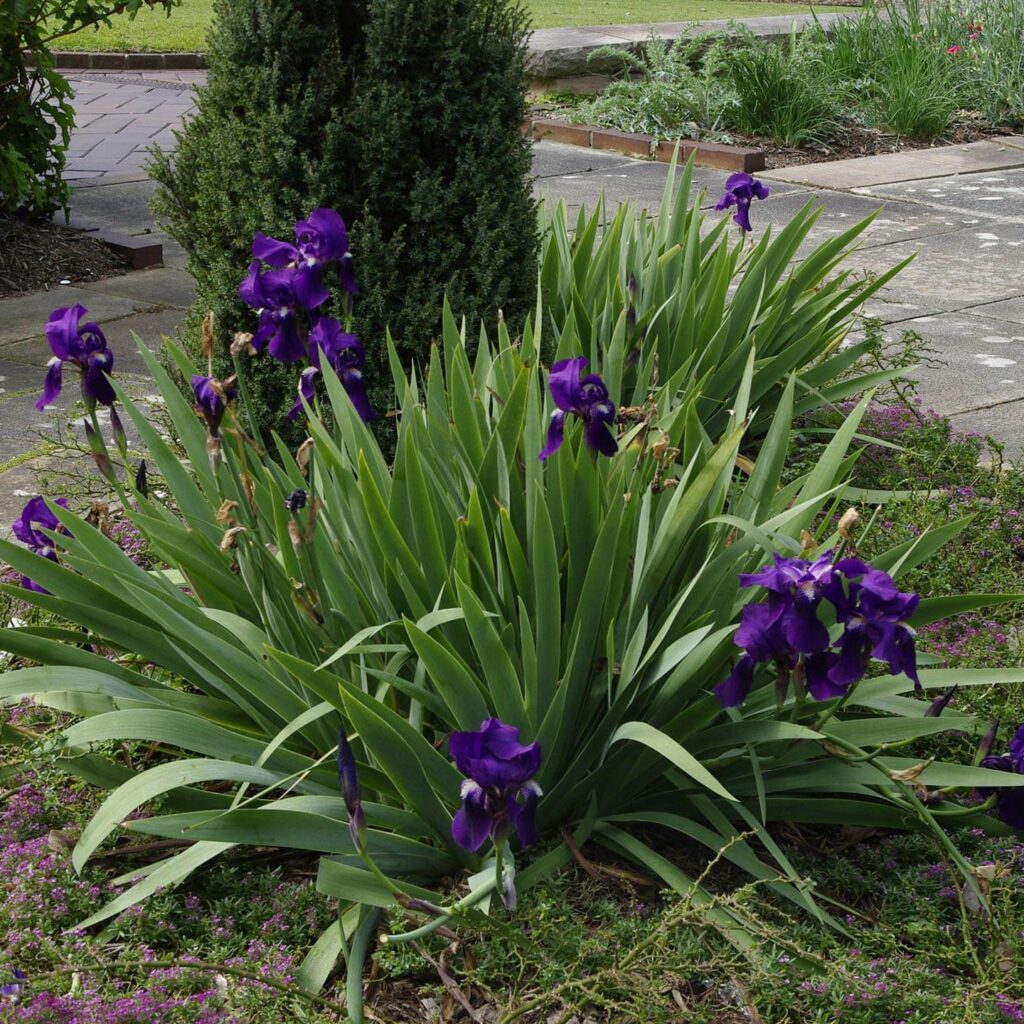
purple iris

Types of bearded irises:

SA  Space Age irises, have something extra, beard appendages called horns, spoons or flounces.

His – historic iris cultivars are any iris introduced over 30 years ago.

MDB – miniature dwarf bearded, to 8″ (20cm) tall, the first beardeds to bloom in earliest spring.

SDB – standard dwarf bearded, 8″ to 16″ (21-40cm) tall, blooms in early spring.

IB – intermediate bearded, 16″ to 27.5″ (41-70cm) tall, blooms after SDB’s and before TB’s.

MTB – miniature tall bearded, 16-27 1/2″ (41-70cm) tall, flowers no more than 6″ (15cm) combined width plus height, blooms with the TB’s.

BB  border bearded 16-27.5″ (41-70cm) tall, blooms with the tall beardeds.

TB – tall bearded more than 27.5″ (71cm) tall, blooms in mid to late spring. 

AB – Arilbred, an iris that is part aril (at least 1/8) and part bearded iris.

Spe – species iris, as originally collected from or found in the wild

Median – All bearded iris classes (SDBs, IBs, BBs, and MTBs) shorter than 27.5,” except the MDBs.

Novelty – can have more than three falls, flat-shaped flowers, irregular color patterns, such as variegated flowers and foliage, and have too many or lack flower parts, such as standards, beards, style arms, etc.

BC – broken color, the petals have irregular splashes of color

Parts of an iris flower:

S – standards – The upturned three petals, (technically called petals) that surround the three style arms.

F – falls – The downturned (can be horizontally flared) three petals, (correctly called sepals) that possess beards.

Petals – A term sometimes used for convenience lumping standards and falls.

B – beards  Elongate groups of fuzzy hairs in the middle at the upper base of all three falls.

Spoons – Appendages extending from the tip of the beards that widen into spoon shaped petaloids.

Horns – A protrusion or extension of the beards, often ending in a point or may be hair covered.

Flounces – Wide, folded, often canoe or fan shapedappendages extending from the tips of the beards.

Style Arms – The three double crested structures inside the three standards, whose horizontal stigmatic lips are pollinated.  (The stamen arise at the base of the style arms extending vertically up their centers.)

Hafts – Areas on each side of the narrow base of the falls, on each side of the beards.

Shoulders – The areas on the arching upper middle part of the fallson each side just beyond the haft areas.

Pistil – The style arms with stigmatic lips connecting to the ovary. The female flower parts.

Claw – The narrow base of the standard and fallthe expanded leaf-like part is called the blade.

Ovary – The enlarged green, three-chambered structure enclosing the ovules where fertilization occurs.

Spathes  – The pair of modified green leaves that enclose the flower bud, usually turning tan after it blooms.

Stamen – The anther plus its attachment filament. The anthers contain the granular pollen. The male flower parts.

iris x germanica

Descriptive terms:

self – standards, style arms and falls are the same color, as a complete self they have the same color beards.

amoena – white standards with anthocyanin and/or carotenoid pigmented falls.

reverse amoena – anthocyanin pigmented standards and white or lighter colored falls, also called a darktop.

Emma Cook pattern – an amoena pattern with white, yellow, pink, peach, or orange standards and narrow, anthocyanin pigmented bordered falls.  The border can also be broader grading from darker at the periphery.

bicolor – standards are a different color than the falls.

bitone – standards and falls are a different shade of the same color, falls are darker.

neglecta – blue or purple bitones with standards a lighter shade of the color of the falls.

reverse bitone – a bitone with the standards a darker shade of the same coloras the lighterfalls.

blend – combination of two or more colors, can be smoothly or unevenly mixed.

variegata – yellow standards and maroon or brown falls.                  

plicata – stippled, dotted, or stitched margins of anthocyanin pigmentation on lighter ground color.

luminata – the reverse pattern of a plicata, with darker ground color and white edges, veins and around beards.

glaciata – these lack all anthocyanin pigments and are pure whites, yellows, pinks, or oranges, formerly called ices.

substance – thickness and resilient tensile strength of the flower parts.                                                           

texture – surface sheen or finish, such as velvety or satiny of the petals.

diamond dusted – tiny, conical raised areasacross the petal surface which shine like diamonds in the light.

silver lining – standards and falls have raised areas on the edges that reflects light in a shining line.

wash – obvious or definite overlay of one color on another.

infusion – faint or subtle overlay of one color on another.

sunburst – white or light streaks fanning out on the falls around, and sometimes beyond, the beards.

spot – darker area around and below the beard on lighter or different colored falls. 

signal – an area or patch  of contrasting color below the beards (usually on arils, and some beardless varieties).

zonal – a distinct white or light area around the beardsin the middle of the falls.

Awards: All AIS awards except ECs are based on voting by AIS judges on performance in the garden.

HC (Highly Commended) for a non-introduced seedling as judged in the garden and receiving five judges votes.

EC (Exhibition Certificate) awarded to the best seedling in an iris show or receiving five votes from judges present.

HM (Honorable Mention) award for an introduced variety, eligible the second year after its introduction.

AM (Award of Merit) required award for eligibility for all yearly awards (eligible the second year after receiving HM).

Yearly awards: given to the top voted cultivar.  In the catalog given with the year awardedsuch as DM 98.

WMM (William Mohr Medal) – award for arilbreds having at least 1/4 Aril ancestry.

CGW (Clarence G. White Medal) – award for pure Arils and Arilbreds with Aril traits and at least 1/2 Aril ancestry.

SM (Sass Medal) – award for Intermediate Bearded irises.

CDM (Cook-Douglas Medal) – award for Standard Dwarf Bearded irises.

CWM (Caparne-Welch Medal) – award for Miniature Dwarf Bearded irises.

KM (Knowlton Medal) – award for Border Bearded irises.

WWM (Williamson White Medal) – award for Miniature Tall Bearded irises.

WC (Walther Cup) – award for the most Honorable Mention votes.

WM (Wister Medal) – award for Tall Bearded irises.

DM (Dykes Medal) – the highest award an iris can receive, any class of iris is eligible, must have won an AM award.

Season of Bloom:

VE (Very Early)

(Early)

(Midseason)

L (Late)

VL (Very Late)

We update our catalog each year, adding an X in front of the Re if it rebloomed for us (in zone 6b). Newer introductions with a zone 7, 8, or 9 after the Re may rebloom in a colder zone (4, 5, or 6) when they become more widely grown.  Rebloomers have a sort of magic, and they can delight you with their extra bloom times. 

Other resources:
Miniature Dwarf Irises
How to Choose the Best Flower Delivery Service in Crows Nest
Finding the Best Florist in Cammeray for Fresh Flower Delivery