Table of Contents
- Iris Crossing
- Easy Genetics
- Easy Lexicon
- Glorious Rebloom
- Live Long and Prosper
- Their Plot
- Top Start from Oz
- Selfed by Crawling Insects
- Look-a-likes
- Select and Collect
- Lasting Signs
Iris Crossing
Parts of this article were prepared for training AIS garden judges on the basics of hybridizing bearded irises – the pogons – that can have exotic fragrances and a complete rainbow of colors to attract pollinators. Bearded irises are placed in classifications based on stalk heights and time of blooming: MDB-miniature dwarf bearded (under 8″) earliest, SDB-standard dwarf (8″ to 16″) early, IB-intermediate (16″ to 27.5″) middle, BB-border (16″ to 27.5″) late, MTB-miniature tall (16″ to 27.5″) late, and TB-tall (over 27.5″) late. In this article, a cultivar without class designation is a TB.
As president of the C & P Iris Society of Region 4, I am directing this summary article to our seven new iris hybridizers, youths 13, 14, 16 and 18 years old, plus three over 19. We have two spring hybridizing clinics where youths may each make five crosses. We provide a hybridizing kit for each youth. I follow their successful seedpods and prepare their seeds; they then plant in their own gardens. Watching with their parents, these youths with their friends gleefully crossing irises in our garden is pure joy. They are the future great hybridizers of the American Iris Society.
Hybridizing irises, like life, may be like a box of chocolates. We do not know what we will get. But learning to be a chef who knows the recipes of the confections may remove some of the mystery. Yet, hybridizing bearded irises will always be more mystery than science. Your hybridizing tweezers, like a magic wand, can create wonderful beauty.
Easy Genetics
This article has been expanded to be clearer and more complete than the 7-page handout in large font, used in the garden judges training. One participant, after looking over the handout, asked me if it was written in English. Many believe that Genetics is Greek to them, it goes over their heads and is beyond their comprehension. Actually, the basics are like the simplest forms of math, like 1+2=3, 2+2=4, and half of 4 is 2. To master Genetics and all its advanced textbooks, for its many applications, would take a lifetime. There are thousands of published journal papers just on the Genetics of the genus Arabidopsis, the wild mustard. To be a successful iris hybridizer, just take the time to learn the basic Genetics presented in this relatively short article. Remember the words of Thomas Jefferson, “Luck favors the prepared mind.” Increasing your basic knowledge of Genetics can increase your chances for hybridizing success.
Easy Lexicon
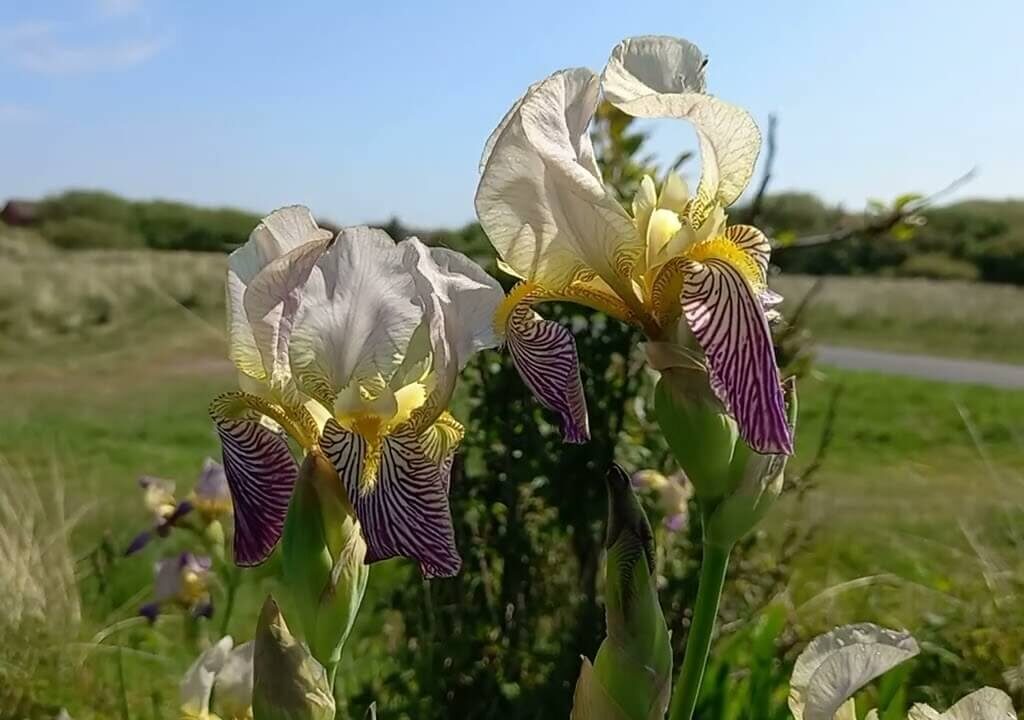
Scientific terminology comes mostly from Greek and Latin. The genus name Iris is from the Greek name for their rainbow goddess. The scientific word for bearded irises is pogon from the Greek word for beard. Whereas “bearded” can be replaced by a different native word in the 7,000+ spoken languages of our 7,000,000,000 humans, the scientific term POGON is always spelled, pronounced, and used to mean the same thing in any language. Pogon separates the bearded irises from the beardless that are called apogon or without beards.
This article uses about 50 scientific words, while avoiding as many as possible. Most educated people know over 50,000 words in their own native tongue. It seems a small task to add to your repertoire of words 50 scientific terms that can be written and pronounced, and have the same meaning in every languages on earth. I was often told, “Use of a dictionary (lexicon) will not cause irreparable brain damage.” Learning to use correctly 50 scientific terms could allow you to grasp the basic genetic concepts needed to successfully hybridize irises.
Glorious Rebloom
We held our judges training in the third week of October, during our Region 4 fall meeting, to showcase many reliable rebloomers in full bloom. Many of these began reblooming in early September; and some like MDB ‘Trimmed Velvet’, SDBs ‘Purple Joy’ and ‘Ray Jones’, and TB ‘Corn Dance’ are so cold hardy, they may continue reblooming until Thanksgiving in our zone 6b. As we continue to intercross the best fall rebloomers, they will produce seedlings that rebloom earlier, even in July and August, with more flower stalks, and with better cold hardiness to withstand fall and spring frosts and freezes.
We envision in the near future when these new rebloomers will compete with chrysanthemums for their vibrant fall colors, growing and reblooming in large, deep pots, then planted in a garden to enjoy in spring and fall. Ginny had a dream about driving around Winchester and being awed by the reblooming irises that blanketed the neighborhoods. My dream is that many youths and youthful minded iris growers will decide to become iris hybridizers so Ginny’s dream can come true.
Live Long and Prosper
For many hybridizers, their incentive for growing, blooming, and hybridizing irises, is to sell their introductions to support their hobby, themselves, or even their family. A hybridizer who masters the procedures and concepts summarized in this article could be seeing their first seedlings bloom in two years and begin selling their first introductions in four to five years. Eventually, they could clear over $10,000 per acre if they use their land as well as their advertising and purchasing funds wisely. You could support a family of four on a five-acre farm with good topsoil.
Their Plot
May I suggest to parents that they offer to their youths a sunny garden plot solely for them to tend of up to 40 by 40 feet. There they can grow their collection of iris cultivars for breeding stock and learn how to hybridize bearded irises as an avocation or possibly a vocation. They will get lots of sun and exercise and eventually earn spending money, and maybe even enough to buy their first vehicle. Each iris cultivar is a living plant with tens of thousands of genes and the ability to produce gloriously beautiful flowers. Bearded irises are the regal queens of any garden scene and are cherished by gardeners as a choice perennial. They are among the easiest perennials to grow, especially the reblooming cultivars.
Top Start from Oz
Repeating the crosses in both directions of top award winners is a good way to start. The brilliant cross that produced for Australian Barry Blyth the zone 9 rebloomer and Wister Medal winning ‘Decadence’, was (Temple of Time X Louisa’s Song). Barry has championed making crosses in both directions, pod X pollen and pollen X pod parents, as the results can be quite different. The potential diversity of seedlings in such a cross is over a quadrillion (at least 24 X 24, 24 times or 24 factorial), and repeating the crosses of other hybridizers should be encouraged. You may also want to add a few self crosses of your tallest and most vigorous cultivars or seedlings. Crossing your best cultivars or seedlings on either parent or its sibling can produce some unique offspring, some superior to either parent. Always save your second best sibling from a cross that produced an exceptional seedling for sibling crosses. Some successful hybridizers believe in limiting their inbreeding at first cousin crosses, yet the results obtained with closer inbreeding in tetraploids such as self, sibling, and parent crosses speak for themselves. Such aversion to closer inbreeding might delay successful progress. For example, I crossed my Wister Medal winning ‘Uncle Charlie’ on a sibling of ‘Lady of Leoness’ from the reverse cross of(Honky Tonk Blues X Silverado) that produced ‘Uncle Charlie’. From this reverse sibling cross, I obtained my ‘Orchid Dove’ that got the most votes for TBs at the Wisconsin AIS National Convention. ‘Orchid Dove’ has several recessive traits not found in either parent or grandparent. I converted their two doses to four doses for hidden recessive traits and expressed lace, orchid pink coloration as seen in the Dykes Medal winner ‘Mary Francis’, dove blue pigment, etc. ‘Orchid Dove’ is a vigorous grower with good increase and is an excellent parent. The master judge Perry Dyer said, “It is gorgeous!” Once an introduction leaves your garden, any praise or awards it receives must be earned on its own merits. AIS garden judges know that their greatest responsibility is to vote for the cultivar and not its hybridizer.
Selfed by Crawling Insects
Random outcrossing seldom produces superior seedlings. In modern bearded irises there are few pods, except in a few dwarfs and MTBs, that are randomly crossed by flying insects like bees and bumblebees, as the stigmatic lips are too highly positioned. This is why you do not have to remove the falls after making a cross as required with beardless irises. Those who have had success planting seeds from bee crosses such as Dick Sparling, most likely planted seeds from a selfing by crawling insects. Failure to remove all three stamens greatly increases the chances for such selfing. Most hybridizers throw away all pods they did not cross. We plant the seeds from such pods on the best cultivars assuming they are self crosses, and have obtained some of our most unique seedlings with good vigor from these mystery pods. We make about 50 self crosses each year that set few pods, yet they can express novel recessive traits and even uncover a new, hidden mutation. Selfing the same flower rarely works. To make a successful self, use mature pollen from an older flower on a newly opened flower.
Look-a-likes
In outcrossing, using look-a-likes is usually more successful than unlikes, in which few seedlings will surpass either parent. (Likes X Likes) is especially important when the traits you are pursuing are recessives, like tangerine beards or the plicata pattern. Once you learn how to hybridize, you will often cross unlikes, as a pink on a plicata. For example, cultivars carrying two recessive, unexpressed doses of plicata like the vigorous, modern flowered bicolor ‘Little John’, with pink standards and lavender falls, are useful when crossed on plicatas or variegated flower pod parents. ‘Little John’ came from a cross of a pink times a reliable plicata rebloomer that gave it two doses of recessive plicata and zone 9 rebloom. Richard Ernst got his Wister Medal winning ‘Ring Around Rosie’ with purple sanded fall pattern with yellow rim with a triple sibling cross {(sib x sib) Sibling X (sib x sib)} of the pink ‘Edna’s Wish’ on the complex plicata ‘Wild Jasmine’. Ernst produced a series ofbeautiful cultivars such as ‘Carnival Ride’ and ‘Looky Loo’ using sibling crosses. George Shoop was probably the greatest master of inbreeding, often using sibling crosses. Study the crosses with dwarfs by the late Bennett Jones in his small garden plot and learn his successful methods. There are many knowledgeable hybridizers who will gladly answer your questions by e-mail, mail, or by phone when they are available, and even schedule you a visit to their garden at a time of day when they are not busy hybridizing.
Select and Collect
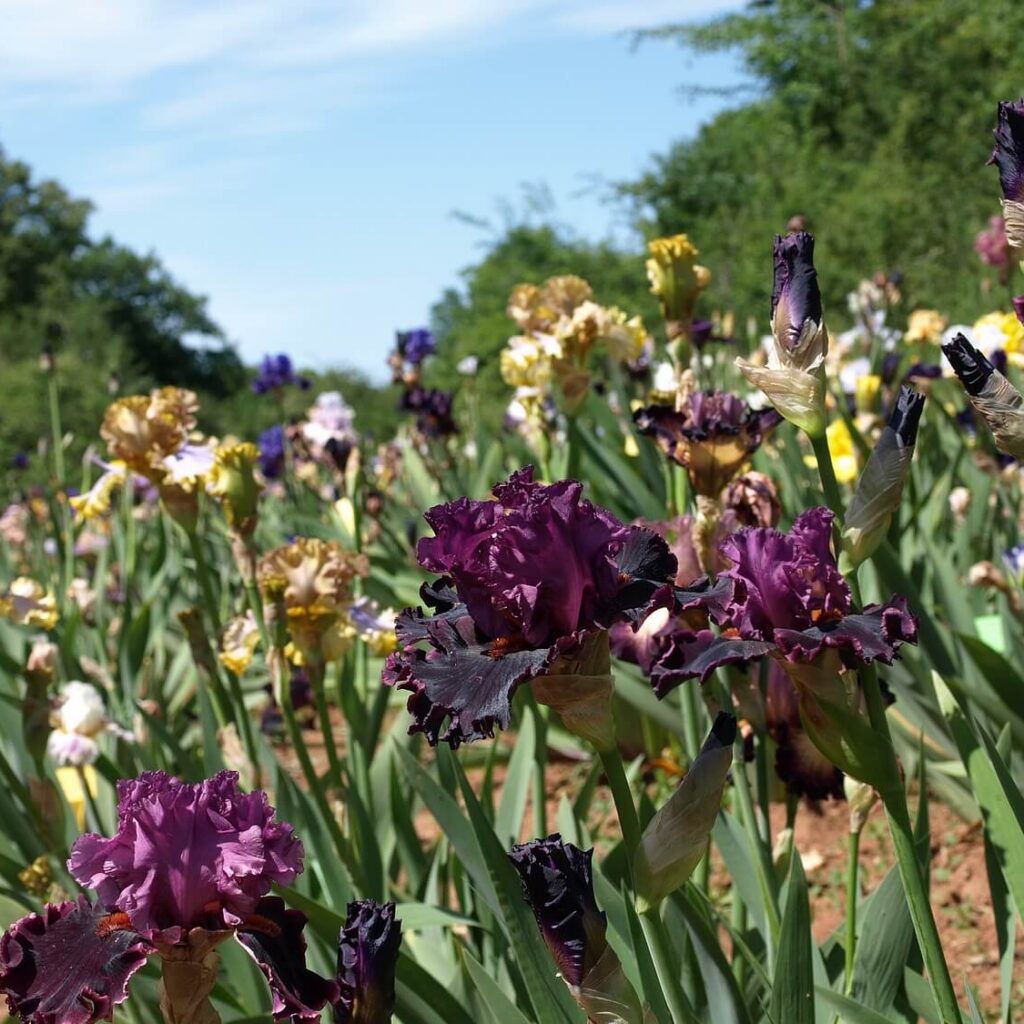
Another successful strategy is to collect and use cultivars that are known to be great parents like ‘I Do’, ‘Vanity’, ‘Titan’s Glory’, ‘Suspicion’, ‘Queen’s Circle’, ‘Romantic Evening’, ‘Fancy Woman’, and ‘My Ginny’. Select for your collection known rebloom carriers like ‘Spinning Wheel’, ‘Yaquina Blue’ and ‘Starring’ that are good parents. Obtain some of the best reliable rebloomers including those that bloom early in the fall as well as late summer. Select those with cold hardy stalks that can withstand early fall and late spring frosts. Other growers may allow you to gather pollen in their gardens or give you flower stalks they entered in shows. Buying or trading for the less expensive, best older cultivars will stretch your funds and still yield good seedlings.
There are many ways to gain knowledge to invest wisely in the newest and best cultivars to use for your specific goals. You can attend local iris shows or regional and national conventions. You can read iris books, catalogs, and articles from the AIS Irises, section publications (The Reblooming Iris Recorder), and Tall Talk. You can search through web sites for commercial sources of irises and the AIS website (irises.org) where you can click on the Iris Encyclopedia <wiki.irises.org>. Iris cultivars over 30 years old are called historics, those newly introduced in the last ten years we call the moderns, and those in between we call classics. As the years progress, there are now many inexpensive classics that are nearly as good as the best moderns.
There are many colors and color patterns found only in the historics and classics that lack reliable rebloom and need improvements in form and vigor. Prices drop from $25-75 (SDBs to TBs) the year of introduction, to $5-15 in five years and $3-5 in ten years. Unlike daylilies, hostas, peonies, etc. costing hundreds of dollars when introduced, only two introduced TB irises, space age ‘Unicorn’ in 1954, and super rebloomer ‘Immortality’ topped out at $100. Now, a few TBs are introduced at $75, but most are $35 – $60. Buying cultivars you have seen performing well in private and commercial gardens in your climate zone is a good practice. Assembling about 100 choice cultivars selected specifically as breeding stock is a good start. If you begin with a single goal where there is little competition, even 5 could be a good start. You have to invest in maintenance of each cultivar you add to your collection, so choose each one carefully. You should feel free to remove from your collection any that under perform in your zone. In your second year, you should have increase from your collection to sell. In a few years, you will have your own vigorous reselects for planned crosses to reach specific goals and begin your program of successful line breeding.
Lasting Signs
For our permanent metal signs we buy rust resistant metal markers from Eon Industries 107 W. Maple Street, P.O. Box 11, Liberty Center, OH 43532-0011 Phone (419) 533-4961, Fax 533-6015. These have thin stainless steel rectangular pieces for the label with two holes at each end and rounded edges that dont cut your arms while weeding. We buy their Nursery Markers with a u-shaped bent wire with two 15 long legs; about 7 goes into the soil. For a few labels, we use Brother P-touch (R) laminated label maker with one inch wide tape for two lines for cultivar name, hybridizer, year of introduction, classification and rebloom.
For larger projects we use Avery(R) 5520 weatherproof address labels from the Staples catalog center. With these Avery(R) labels you should use a laser printer that wont wash off. Ginny uses a database, either from Works or Excel. Then she selects the fields to print, and can make hundred of labels this way. These labels last 10 years or more without fading. Put the stainless steel rectangle with label affixed on the two wire legs with the label upside down and bend the top at a 45 degree angle, which turns the label right side up, then it wont slide down the wires from winter snows. These permanent metal signs each cost about $1 to make.
An inexpensive way to make signs to label reselects and seedbed crosses is to use 9 sections of 1 wide vinyl venetian blinds. Insert by the cut pointed end halfway into the soil. Repeat the information in the top and bottom half so if the top is broken off by an animal, you still have it labeled. A pencil will write on this vinyl surface and the graphite will stay indefinitely, unlike permanent markers whose ink is removed by sunlight in a year or less. Punch a hole in the bottom end of the vinyl strip. Then wrap on itself a thick rubber band through the hole that will prevent the sign from heaving in winter. Keep current your maps of all your garden plantings. Animals can remove signs. Making maps should be the first thing you do when you plant.
Other resources:
Finding the Best Florist in Cammeray for Fresh Flower Delivery
Iris Descriptions
How to Choose the Best Flower Delivery Service in Crows Nest